EvoFit Trainer — Deep Dives
In this article
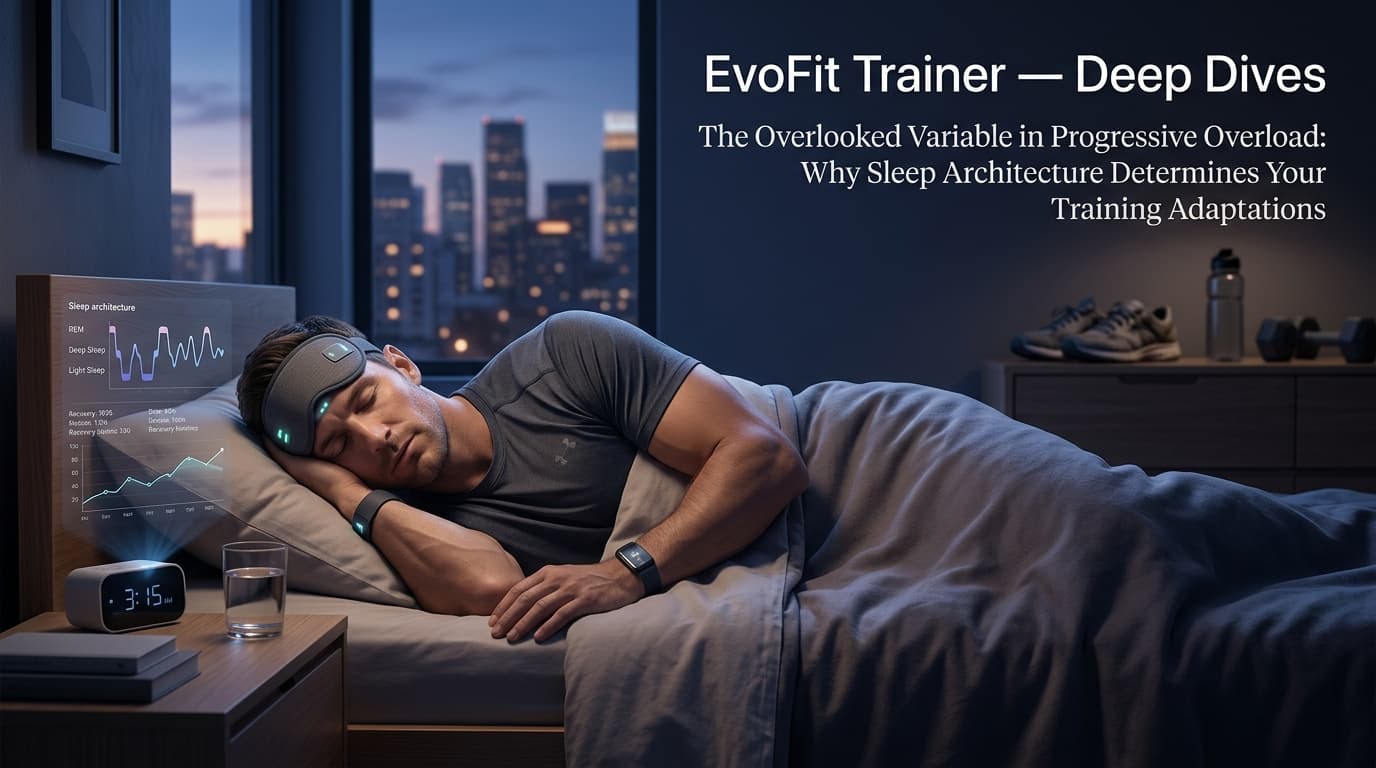
The Overlooked Variable in Progressive Overload: Why Sleep Architecture Determines Your Training Adaptations
When we talk about progressive overload, the conversation almost always centres on what happens inside the gym. We analyse set and rep schemes, debate the merits of RPE versus percentage-based programming, and track barbell velocity down to the centimetre per second. But the physiological reality of adaptation—the actual process of growing stronger, building tissue, and increasing work capacity—happens almost entirely outside of our training sessions.
At EvoFit, our AI-driven programming engine does not just calculate your training volume; it factors in the biological reality that your progress is capped by your recovery. And among all recovery variables, sleep is the most consequential, the most measurable, and frequently the most neglected.
Here is a deep dive into the science of sleep architecture, chronotypes, and how understanding this data allows us to build better, more individualised training protocols.
The Mechanics of Sleep and Physical Recovery
To understand why sleep dictates your training outcomes, we have to look at what happens to the body during the different cycles of a standard night's rest. Sleep is not a monolithic, passive state; it is a highly active, phased neurological process.
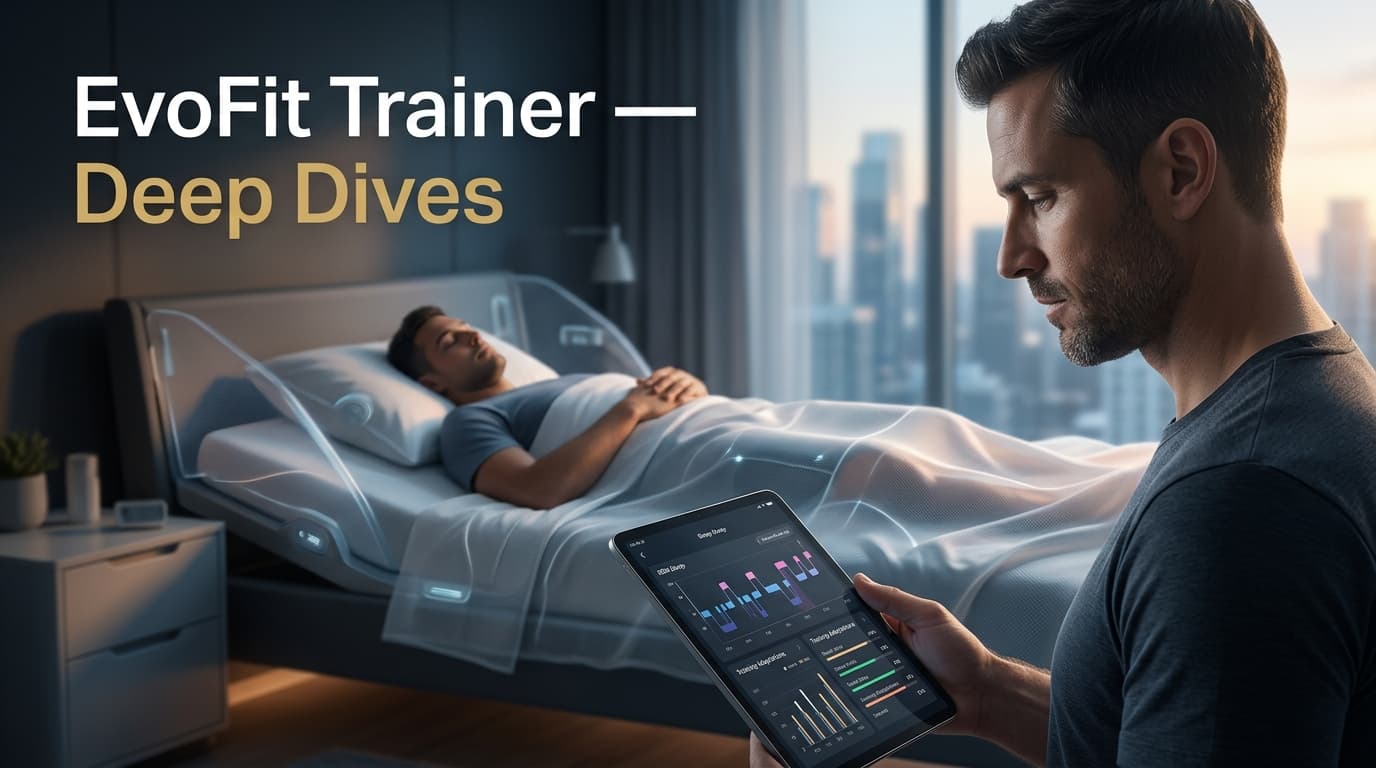
Research indicates that sleep serves distinct restorative functions that directly impact an athlete's physical output and subsequent recovery (Pyzik et al., 2026). During the deepest stages of non-rapid eye movement (NREM) sleep, the body experiences a significant release of growth hormone, which plays a vital role in tissue repair and muscle adaptation. Furthermore, the central nervous system uses this time to clear metabolic waste products that accumulate during high-intensity exercise.
If training volume is increased without a corresponding increase in sleep quality, the athlete's physical performance metrics consistently decline (Geoffroy, 2026). We observe this in the data as a reduction in power output, slower reaction times, and compromised mechanical efficiency. Simply put, you cannot out-program poor sleep.
Chronobiology: Timing Training to Your Internal Clock
One of the most fascinating frontiers in exercise science is chronobiology—the study of how our internal circadian rhythms affect our physiology. Not all athletes are built to train at the same time of day.
Chronotypes (an individual's biological predisposition toward being a "morning lark" or a "night owl") have a measurable impact on athletic output. Lim et al. (2020) observed that athletes tend to perform better, and report higher sleep quality, when their training schedules are aligned with their specific chronotype.
When an athlete is forced to train in direct opposition to their circadian rhythm (for example, a night-owl chronotype performing maximal heavy lifting at 6:00 AM), researchers note disruptions in both acute performance markers and subsequent sleep architecture (Lim et al., 2020).
This is precisely why static, unchangeable workout templates fail. When you input your schedule and lifestyle data into EvoFit Trainer, our AI uses these chronobiological principles to recommend optimal training windows. By aligning your most demanding neurological sessions (like heavy compound lifts) with your biological peak times, the system maximizes the adaptive response to the stimulus.
Sleep Extension and the Cost of Sleep Debt
In modern athletic programming, "sleep debt"—the cumulative gap between the sleep an athlete needs and the sleep they actually get—is treated as a primary barrier to progressive overload.
When athletes experience acute sleep deprivation, the immediate effects include a drop in motivation, increased perception of effort, and impaired cognitive function (Bird, 2013). However, the long-term consequences of chronic sleep restriction are far more detrimental to periodized programming. Prolonged sleep debt alters endocrine responses, elevating catabolic hormones (like cortisol) while suppressing anabolic pathways.
Conversely, studies on "sleep extension"—where athletes intentionally increase their time in bed to 9–10 hours nightly—have been associated with improvements in reaction time, mood, and daytime sleepiness (Bird, 2013). The evidence suggests that when athletes proactively manage their sleep duration, they build a larger physiological buffer, allowing them to tolerate higher volumes of training intensity without entering a state of overreaching.
Cognitive Rehearsal and the Dreaming Brain
The role of sleep in physical adaptation extends beyond tissue repair into the realm of cognitive and neurological consolidation.
The brain remains highly active during rapid eye movement (REM) sleep. For athletes, this period is critical for motor learning and skill acquisition. Erlacher and Ehrlenspiel (2017) note that sleep facilitates the consolidation of procedural memories—meaning the physical skills, new movement patterns, and technical lifts you practice during the day are neurologically "wired" and refined while you sleep.
Furthermore, dream content specific to athletic performance has been observed among competitive athletes. Erlacher and Ehrlenspiel (2017) highlight that dreams can serve as a form of mental rehearsal. The neurological pathways activated when an athlete visualizes a successful clean-and-jerk or a complex gymnastics transition in a dream are strikingly similar to the pathways activated during physical execution. Disrupting REM sleep means disrupting the brain's ability to master the technical elements of your EvoFit programming.
How EvoFit Trainer Integrates Recovery into Progressive Overload
Traditional progressive overload methodology operates on a simplistic equation: Do more work over time. Add five pounds to the bar. Do one more rep. Run one mile further.
At EvoFit, our AI operates on a more sophisticated premise: Apply the maximum recoverable amount of work over time.
If you are logging poor subjective sleep scores, high stress, or short sleep durations in the EvoFit app, the AI dynamically adjusts your macrocycle. Rather than forcing a scheduled increase in training volume—which the biological data suggests would only result in diminished returns or injury (Geoffroy, 2026)—the algorithm may prescribe a deload week, alter your exercise selection to favor lower-neurological-demand movements, or shift your primary session to a later time slot that aligns with your chronotype (Lim et al., 2020).
What This Means for Your Programming
We do not diagnose sleep disorders, nor do we provide medical interventions for sleep pathology. However, we recognise that programming a high-intensity resistance training block for an individual averaging five hours of fragmented sleep contradicts the current understanding of exercise physiology.
By viewing sleep as the foundational pillar of progressive overload, EvoFit Trainer ensures that every set, rep, and session you log is precisely calibrated not just to your goals, but to your biological reality. Training without adequate recovery is merely fatigue management. Training built around your physiological data is how adaptations actually happen.
References
Bird, S. (2013). Sleep, recovery, and athletic performance. Strength & Conditioning Journal, 35(5), 43–47. https://doi.org/10.1519/ssc.0b013e3182a62e2f
Erlacher, D., & Ehrlenspiel, F. (2017). Sleep, dreams, and athletic performance. In Sleep and neurophysiology (pp. 225–240). Routledge. https://doi.org/10.4324/9781315268149-12
Geoffroy, P. (2026). Physical activity, athletic performance, and recovery: The role of sleep. Encéphale, 52(3), 45–54. https://doi.org/10.1016/j.encep.2026.03.005
Lim, S., Kim, D., Kwon, H., et al. (2020). Sleep quality and athletic performance according to chronotype. Research Square Preprint. https://doi.org/10.21203/rs.3.rs-50104/v3
Pyzik, A., Polakowska, A., Dziegciarczyk, A., et al. (2026). Restoring the athlete: The role of sleep in athletic performance and recovery. Quality in Sport, 52, 69361. https://doi.org/10.12775/qs.2026.52.69361
EvoFit Team
AI-powered fitness science, nutrition research, and coaching strategies for the modern fitness professional.