EvoFit Trainer — Deep Dives
In this article
Welcome back to the EvoFit Trainer Deep Dives. In this series, we take a rigorous, evidence-based look at the fundamentals of workout programming, nutrition science, and progressive overload methodology. Our goal is to break down the research so you can understand the mechanics behind how EvoFit Trainer uses AI to personalize your fitness and nutrition protocols.
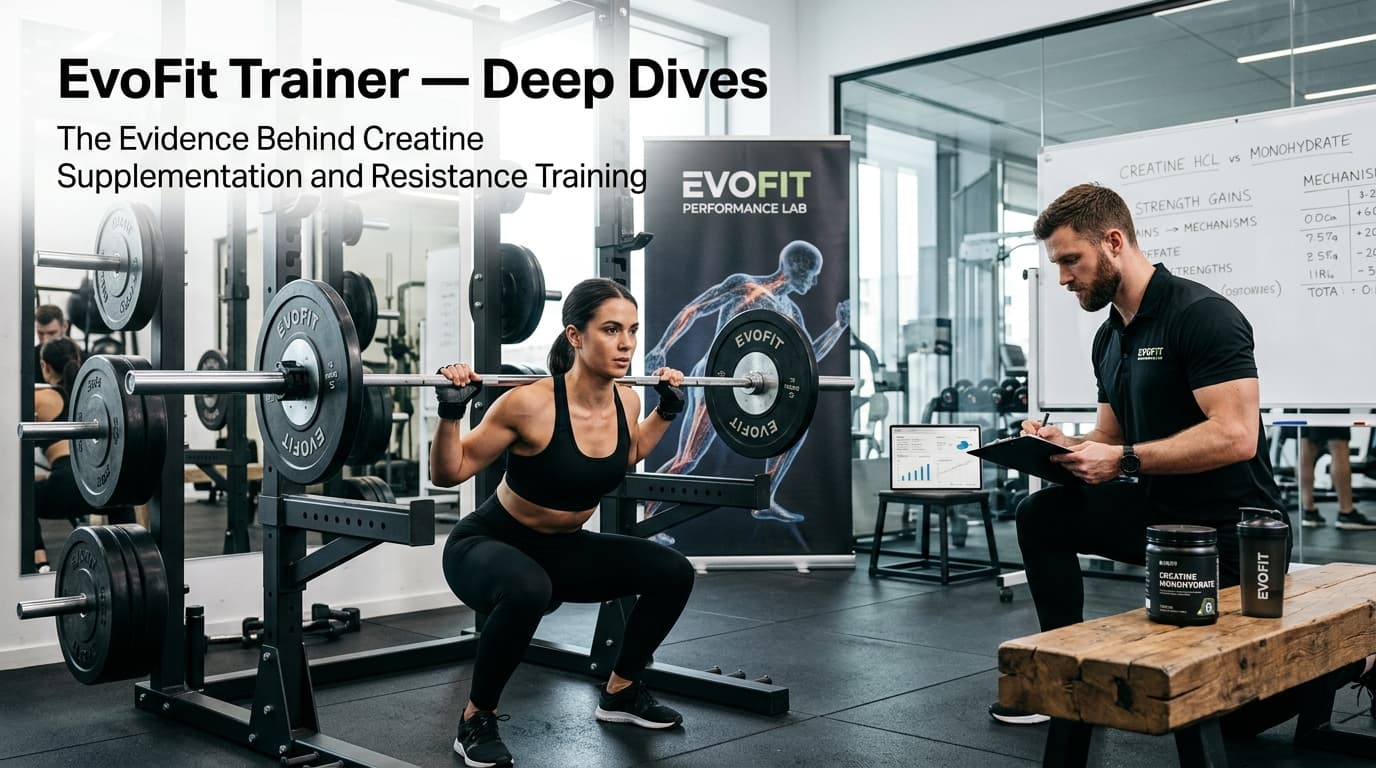
Today, we are exploring one of the most extensively researched supplements in sports nutrition: creatine monohydrate. We will examine what the current scientific literature says about its relationship with lean tissue mass and muscular strength across different populations, and how the EvoFit Trainer AI interprets this data when individualizing user plans.
The Baseline: Creatine and Resistance Training
To understand the role of any nutritional intervention, we first have to look at how it interacts with mechanical stimulus—specifically, resistance training.
In a systematic review and meta-analysis examining young men, researchers compared the effects of creatine supplementation under resistance training versus non-resistance training conditions. The authors observed that when creatine supplementation was paired with resistance training, it was associated with measurable increases in muscular strength, physical performance, and lean mass compared to non-resistance training control conditions (Gu et al., 2026). A subsequent correction to this paper was published to address administrative formatting errors, but the core data extraction and analytical methodology of the review remained intact (Gu et al., 2026).
This aligns with earlier foundational research. An early controlled study evaluating male weightlifters found that creatine monohydrate supplementation was associated with enhancements in strength and lean body mass, as well as specific physical circumferences, when compared to a placebo group undergoing the same training regimen (Wood et al., 1998). More recently, a systematic review focusing on creatine supplementation during strength training sessions evaluated its effects on muscular force and resistance, reporting that the compound was associated with positive adaptations in strength metrics during resistance training protocols (Pinho & Malinovski, 2025).
Age-Related Populations and Clinical Realities
At EvoFit Trainer, our AI does not rely on broad, one-size-fits-all assumptions. A critical part of personalizing a fitness plan is recognizing the boundaries of the data. Scientific literature often highlights that findings in one demographic do not automatically translate to others.
For instance, when researchers evaluate the effects of compounds across different age groups, the data shifts. In a meta-analysis assessing older adults, creatine supplementation combined with resistance training was associated with increases in lean tissue mass and muscular strength in this specific population (Chilibeck et al., 2017).
However, it is crucial to recognize where associations break down entirely, particularly in clinical populations. In a specific study examining patients with myotonic dystrophy type 1, researchers observed that creatine monohydrate supplementation was not associated with any increases in muscle strength, lean body mass, or muscle phosphocreatine in these individuals (Tarnopolsky et al., 2003).
This distinction is vital. The EvoFit Trainer AI operates on the principle that nutrition and training interventions are highly context-dependent. We do not assert that creatine, or any compound, universally solves performance deficits or alters physiology independent of training stimuli or underlying health conditions. Instead, our system looks at the available population data to inform the baseline recommendations it generates.
How EvoFit Trainer Integrates the Evidence
Understanding progressive overload methodology requires a comprehensive view of both stimulus (training) and recovery (nutrition). Here is how the EvoFit team utilizes findings like these to inform our AI architecture:
- Contextual Recommendations: The AI categorizes recommendations based on user inputs, such as age and training history. If a user is an older adult engaging in a new resistance training program, the AI understands the literature showing a positive association between creatine, lean tissue mass, and strength in that demographic (Chilibeck et al., 2017).
- Training Synergy: The algorithms are built to reinforce that supplements act as an adjunct to, not a replacement for, programming. The data clearly indicates that the associations between creatine and performance are most pronounced when resistance training is the primary driver (Gu et al., 2026; Pinho & Malinovski, 2025).
- Strict Boundaries on Health Claims: EvoFit Trainer does not diagnose, treat, or give dosing advice. The AI will never prescribe a therapeutic protocol for a medical condition. We are acutely aware that in clinical populations, interventions perform differently, as evidenced by the lack of physiological adaptation in patients with myotonic dystrophy type 1 (Tarnopolsky et al., 2003).
Our platform is designed to report the evidence exactly as it stands. By layering this nutritional science over our workout programming and progressive overload methodology, EvoFit Trainer creates a highly individualized, data-driven roadmap for your fitness journey.
We will continue to monitor the latest peer-reviewed literature to ensure our AI's logic remains aligned with the highest standards of sports science.
Disclaimer: EvoFit Trainer does not diagnose, treat, or provide dosing administration advice for any medical conditions or supplements. All nutritional strategies generated by the platform are for general fitness and wellness purposes. Always consult with a qualified healthcare professional before beginning any new supplementation or exercise program.
References
Chilibeck, P., Kaviani, M., Candow, D., et al. (2017). Effect of creatine supplementation during resistance training on lean tissue mass and muscular strength in older adults: A meta-analysis. Open Access Journal of Sports Medicine, 8, 1–12. https://doi.org/10.2147/oajsm.s123529
Gu, J., Li, Y., Xiao, J., et al. (2026a). Creatine supplementation in young men under resistance versus non-resistance training: A systematic review and meta-analysis of strength, performance, and lean mass. Frontiers in Nutrition, 13, 1800546. https://doi.org/10.3389/fnut.2026.1800546
Gu, J., Li, Y., Xiao, J., et al. (2026b). Correction: Creatine supplementation in young men under resistance versus non-resistance training: A systematic review and meta-analysis of strength, performance, and lean mass. Frontiers in Nutrition, 13, 1854605. https://doi.org/10.3389/fnut.2026.1854605
Pinho, T., & Malinovski, J. (2025). Suplementação de creatina e performance muscular quais os efeitos da suplementação de creatina na força e resistência durante sessões de treino de força [Creatine supplementation and muscular performance what are the effects of creatine supplementation on strength and resistance during strength training sessions]. Revista Científica Multidisciplinar Odonto e Saúde, 1(2), 1265. https://doi.org/10.51473/rcmos.v1i2.2025.1265
Tarnopolsky, M., Mahoney, D., Thompson, T., et al. (2003). Creatine monohydrate supplementation does not increase muscle strength, lean body mass, or muscle phosphocreatine in patients with myotonic dystrophy type 1. Muscle & Nerve, 27(4), 454–460. https://doi.org/10.1002/mus.10527
Wood, K., Zabik, R., Dawson, M., et al. (1998). The effects of creatine monohydrate supplementation on strength, lean body mass, and circumferences in male weightlifters. Medicine & Science in Sports & Exercise, 30(5), S258. https://doi.org/10.1097/00005768-199805001-01541
EvoFit Team
AI-powered fitness science, nutrition research, and coaching strategies for the modern fitness professional.