EvoFit Trainer — Deep Dives
In this article
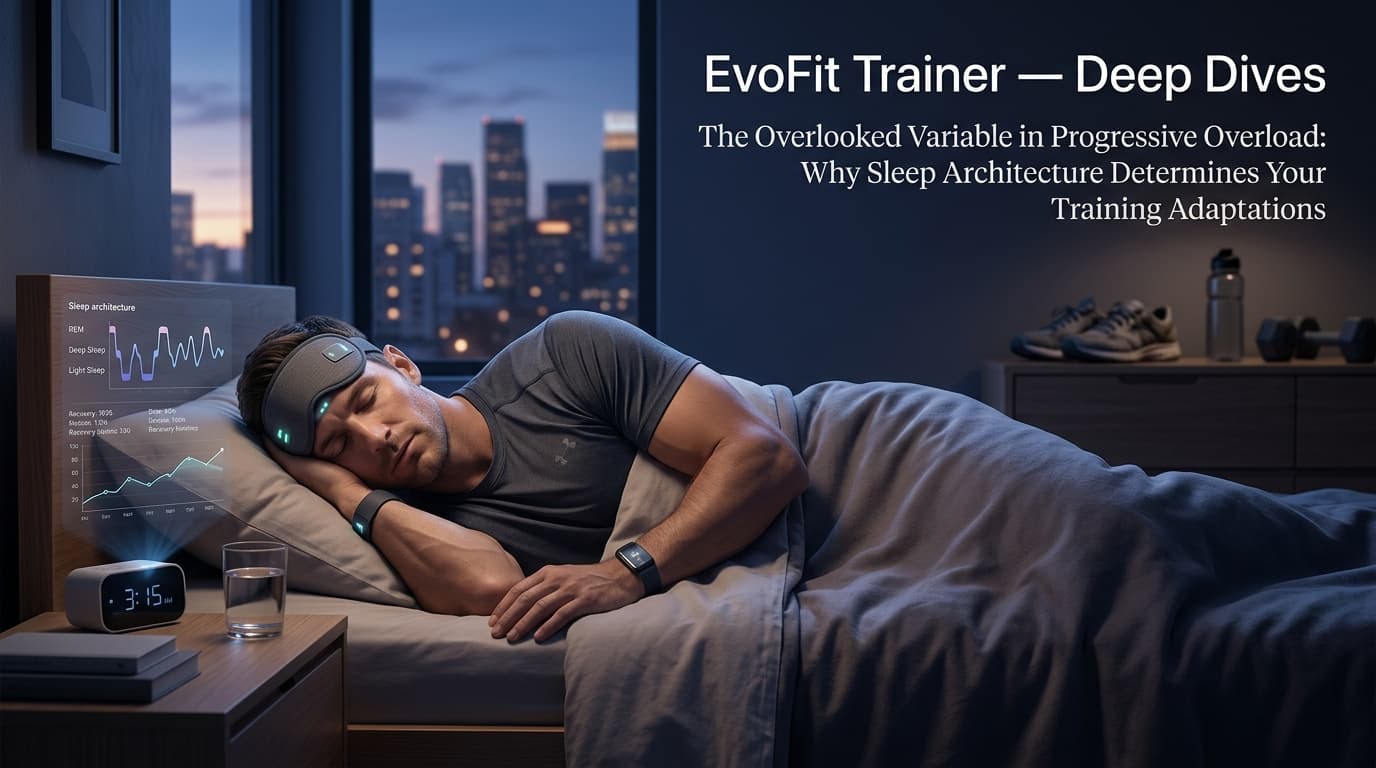
The Hidden Variable in Progressive Overload: Why Sleep Architecture Determines Your Training Adaptations
When we built EvoFit Trainer, we spent months engineering an AI that could calculate optimal volume, intensity, and frequency for any given user. We modelled progressive overload curves, fatigue indices, and autoregulation thresholds. But early in development, our team encountered a persistent pattern: two users with nearly identical baseline metrics, following nearly identical programming, would produce wildly divergent outcomes.
The variable wasn't their nutrition. It wasn't their exercise form. It was their sleep.
In the strength and conditioning community, sleep is frequently mentioned as a footnote in recovery protocols. The EvoFit team argues that this is a fundamental categorisation error. Sleep is not merely a passive recovery state; it is the foundational biological window during which training adaptations are actualised. If your sleep architecture is fractured, the most meticulously programmed progressive overload protocol is built on quicksand.
Here is a deep dive into the current literature on sleep and athletic performance, and how EvoFit Trainer uses this data to adjust your daily training stimulus.
The Neurobiology of Training Adaptation
Resistance training does not build muscle; it damages it. The synthesis of new contractile tissue—along with the neurological adaptations that drive strength gains—occurs primarily during sleep, specifically during the deeper stages of non-rapid eye movement (NREM) sleep. During slow-wave sleep (SWS), the pituitary gland releases pulses of growth hormone, which facilitate tissue repair and muscle remodelling (Bird, 2013).
Furthermore, sleep is the period where the central nervous system (CNS) clears metabolic byproducts accumulated during waking hours. Researchers have observed that without adequate time in these deeper sleep stages, the neuromuscular system fails to fully recuperate, which can blunt the anabolic response to resistance training and delay the clearing of systemic fatigue (Pyzik et al., 2026).
If you are applying mechanical tension to your muscles via progressive overload, you are essentially writing a cheque that your sleep must cash.
Chronotype: The Genetic Variable You Cannot Ignore
Have you ever noticed that you feel noticeably stronger at 7:00 PM compared to 7:00 AM? This isn't purely a matter of habit; it is heavily dictated by your chronotype—your body's natural circadian preference for sleep and wakefulness.
In research examining chronobiology and strength output, evening chronotypes (often referred to as "night owls") and morning chronotypes ("early birds") experience peak physical performance at different times of the day. Crucially, training outside of one's circadian preference has been associated with suboptimal performance outputs. A study by Lim et al. (2020) observed that when athletes were forced to perform high-intensity efforts outside of their circadian peak—specifically, morning types training late at night, or evening types training early in the morning—their performance metrics suffered.
Interestingly, the research also notes that maintaining a consistent sleep schedule can partially mitigate these circadian mismatches, but the underlying genetic chronotype remains a powerful driver of both sleep quality and acute athletic output (Lim et al., 2020).
Cognitive Function, Reaction Time, and Injury Risk
Fitness programming isn't just about pushing maximum weight; it is about executing complex motor patterns under load. Squatting heavy weight or performing explosive Olympic lifts requires precise neuromuscular coordination, balance, and spatial awareness—all cognitive functions highly sensitive to sleep deprivation.
In a comprehensive review of sleep and athletic recovery, Geoffroy (2026) notes that sleep restriction is consistently associated with decreased cognitive function, impaired reaction time, and compromised executive functioning in athletes.
The implications for resistance training are significant. When sleep debt accumulates, reaction times slow, and proprioception (your body's awareness of its position in space) degrades. This dramatically increases the risk of technical breakdown during a heavy set, which is a primary driver of acute gym injuries. The evidence suggests that tired athletes don't just lift less weight; they move differently, and less safely (Geoffroy, 2026).
REM Sleep and Motor Learning
Beyond physical tissue repair, sleep plays a critical role in motor learning—the process by which your brain wires new movement patterns into your nervous system. When you learn a new lift, such as a snatch or a Turkish get-up, your brain relies on sleep to consolidate that motor memory.
This occurs primarily during rapid eye movement (REM) sleep and lighter Stage 2 NREM sleep. Erlacher and Ehrlenspiel (2017) outline how the sleeping brain actively processes and integrates new motor skills learned during the day. If you are trying to master a complex new movement pattern, but you are chronically truncating your sleep to wake up for early workouts, you are actively inhibiting your own skill acquisition. Your brain simply has less time in the REM cycles required to "upload" the motor pattern to your long-term memory (Erlacher & Ehrlenspiel, 2017).
How EvoFit Trainer Integrates Sleep Architecture into AI Programming
Understanding the literature is only half the battle; the challenge is operationalising it. Traditional static programs operate on a fixed timeline: Monday is squats, Wednesday is bench, Friday is deadlifts, regardless of how you slept the night before.
EvoFit Trainer takes a dynamic, evidence-based approach. Because we know that sleep restriction impairs cognitive function, alters hormone profiles, and degrades neuromuscular efficiency, our AI does not blindly demand a 5% volume increase if your readiness metrics indicate poor sleep.
Here is how EvoFit Trainer adapts your programming based on the data:
1. Chronotype-Aware Scheduling If you log your training sessions and report consistently lower outputs in early morning sessions, EvoFit Trainer's algorithm notes the pattern consistent with evening chronotype data (Lim et al., 2020). Where possible, it will optimise your high-intensity neural days (heavy singles, triples, and explosive work) to align with the time blocks where your logged performance is statistically highest.
2. Autoregulated Volume and Intensity If you log poor sleep duration or quality, EvoFit Trainer temporarily adjusts your daily training stimulus. Because we know that sleep deprivation increases injury risk and impairs tissue repair (Geoffroy, 2026), the AI will shift your daily protocol away from high-central-nervous-system demands. Instead of pushing for a new 1-repetition maximum, the system will dynamically adjust your working weights and prescribe higher-repetition, lower-intensity accessory work. This allows you to stimulate blood flow and maintain the habit of training without pushing a compromised system past its safe limits.
3. Prioritising Skill Acquisition on High-REM Days When you introduce a completely new, technically demanding movement into your routine, EvoFit Trainer factors in your recent sleep quality. If you are well-rested, the AI knows your brain has the necessary REM capacity to wire the new motor patterns efficiently (Erlacher & Ehrlenspiel, 2017). If you are sleep-deprived, attempting to learn a complex new lift is unproductive; the AI will stick to familiar movement patterns until your readiness improves.
The Bottom Line
At EvoFit, we view training, nutrition, and sleep as an interconnected triad. You cannot out-program poor sleep, and you cannot out-sleep poor programming. The most effective training plans are those that respect human physiology and adapt to it in real time.
Progressive overload is not a linear math equation; it is a biological negotiation. EvoFit Trainer ensures that you are only asking your body for output when the biological environment is primed to deliver it safely and effectively.
Disclaimer: EvoFit Trainer does not diagnose, treat, or provide medical advice for sleep disorders. The AI adjustments described above are designed for fitness programming and autoregulation, not therapeutic intervention. Always consult a qualified medical professional regarding persistent sleep disturbances or health concerns.
References
Bird, S. (2013). Sleep, recovery, and athletic performance. Strength & Conditioning Journal, 35(5), 43–47. https://doi.org/10.1519/ssc.0b013e3182a62e2f
Erlacher, D., & Ehrlenspiel, F. (2017). Sleep, dreams, and athletic performance. In The Oxford handbook of sleep and dreams (pp. 213–228). Routledge. https://doi.org/10.4324/9781315268149-12
Geoffroy, P. (2026). Physical activity, athletic performance, and recovery: The role of sleep. L'Encéphale, 52(3), 69–75. https://doi.org/10.1016/j.encep.2026.03.005
Lim, S., Kim, D., Kwon, H., Park, J., & Lee, Y. (2020). Sleep quality and athletic performance according to chronotype. Research Square Preprint. https://doi.org/10.21203/rs.3.rs-50104/v2
Pyzik, A., Polakowska, A., Dziegciarczyk, A., Kowalski, J., & Smoleń, A. (2026). Restoring the athlete: The role of sleep in athletic performance and recovery. Quality in Sport, 52, 69361. https://doi.org/10.12775/qs.2026.52.69361
EvoFit Team
AI-powered fitness science, nutrition research, and coaching strategies for the modern fitness professional.