EvoFit Trainer — Deep Dives
In this article
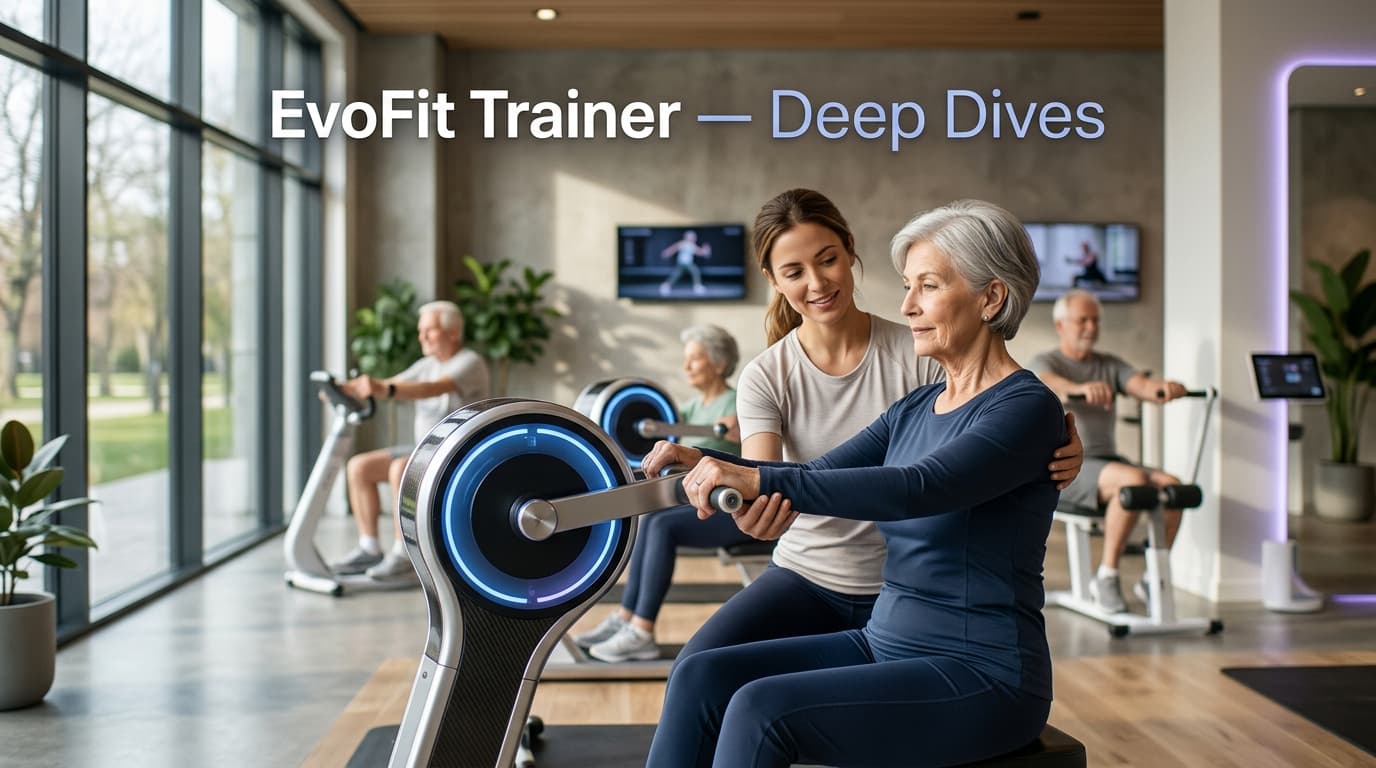
Welcome back to the EvoFit Trainer Deep Dives. Today, the EvoFit team is looking closely at a demographic that is entirely underserved by standard fitness technology: older adults.
When we built the EvoFit Trainer, we knew that a one-size-fits-all algorithmic approach to fitness would inevitably fail a significant portion of the population. Standard applications often prescribe generalized linear progressions—adding five pounds to a lift each week—without accounting for the complex neurological and biomechanical realities of aging. To build an AI that truly personalizes fitness plans, we had to look deeply into the literature surrounding how older adults respond to resistance training, balance interventions, and movement control.
Here is what the science tells us about programming for the aging population, and how we apply these insights.
The Biomechanics of Aging: More Than Just Muscle
In standard fitness paradigms, resistance training is viewed primarily as a tool for muscular hypertrophy. However, when analyzing the literature surrounding older adults, it becomes clear that resistance training serves a much broader purpose. As highlighted in current literature on chronic disease management, resistance training for older adults is fundamentally linked to the management and mitigation of age-related physical decline [2]. But the mechanism is not solely muscle accrual; it involves profound neurological adaptation.
This is where the concept of movement control becomes critical to workout programming. The influence of resistance training on older adults extends beyond pure force production to how they control their bodies in space [4]. When an older adult engages in a structured resistance program, the central nervous system adapts. Researchers have observed that resistance training fundamentally influences the biomechanical frameworks older adults use to maintain stability and execute complex motor patterns [4]. For the EvoFit Trainer AI, this signals a necessity: our algorithms cannot merely track load and volume; they must factor in movement quality, tempo, and neurological readiness, treating every set as both a muscular and a motor-control stimulus.
Velocity-Based Training and Power Generation
If movement control is the destination, velocity is the vehicle. Historically, gym culture has prioritized slow, controlled repetitions to maximize time under tension. While hypertrophy remains important for older populations to preserve muscle mass—as dietary protein distribution and resistance exercise work synergistically to support muscle health in older adults [1]—relying solely on slow-tempo lifting ignores a critical element of functional fitness: power.
Muscle power—the ability to produce force rapidly—declines at a steeper rate than absolute muscle strength as humans age. To address this, researchers are exploring maximal-intentional velocity resistance training interventions for older adults [3]. This methodology requires the trainee to move the load as quickly as possible during the concentric phase of the lift, regardless of the actual bar speed.
Designing and implementing maximal-intentional velocity interventions requires a nuanced understanding of programming [3]. If a training plan only calls for slow, grueling sets, the nervous system loses its capacity to recruit fast-twitch muscle fibers quickly. At EvoFit, our AI personalizes these variables by cycling through blocks of accumulation (focused on hypertrophy and slower tempos) and intensification (focused on maximal intentional velocity and power output). By automating these periodization shifts, EvoFit Trainer ensures that older users are building both the foundational strength and the rapid nerve conduction required for daily functional tasks.
Functional-Task Training Versus Traditional Resistance
Programming for older adults ultimately forces a philosophical question: What is the purpose of the training? If the goal is strictly physiological isolation, traditional machine-based resistance training works. But if the goal is holistic balance and life independence, the programming must shift.
A fascinating comparative study asked whether functional-task training is better than traditional resistance training at enhancing balance in older adults [5]. What researchers observed is that while traditional resistance training builds the necessary foundational strength in the lower extremities, functional-task training—which integrates multi-planar movements mirroring daily activities—demonstrates distinct advantages in dynamic balance enhancement [5].
In short, strength built on a leg press machine does not automatically transfer to the complex stabilizing requirements of walking on an uneven surface or recovering from a trip. True balance requires the integration of sensory feedback and multi-joint coordination. EvoFit’s AI leverages this data by dynamically blending traditional resistance movements with functional-task variations. If the algorithm detects plateaus in primary compound lifts, it automatically introduces unilateral, multi-planar functional tasks to challenge the user's dynamic stability.
Inclusion Through Intelligent Programming
The ultimate goal of examining this research is to build a tool that creates access. Analyzing strategies for strength training reveals that personal trainers play an essential role in promoting the health of older adults, as well as individuals with special needs [6]. The barrier to entry for these populations has historically been the high cost of one-on-one human coaching required to safely navigate their complex physical limitations.
By integrating the science of movement control [4], the implementation of maximal-intentional velocity [3], and the balance-enhancing benefits of functional-task training [5] into our underlying architecture, EvoFit Trainer acts as an adaptive digital coach. Our AI does not merely scale weights up and down; it scales complexity, velocity, and modality based on user feedback and performance data.
As we continue to develop the EvoFit Trainer platform, the team remains committed to reflecting the totality of the current evidence. Whether you are an athlete looking to optimize progressive overload or an older adult aiming to preserve functional independence, intelligent, science-backed programming is the foundation of sustainable physical fitness.
Disclaimer: EvoFit Trainer does not diagnose, treat, or provide medical advice. The AI-generated plans are designed for fitness purposes. Always consult with a healthcare professional before beginning a new exercise program, especially if you have underlying health conditions.
References
Andrade, S. (2021). Treinamento de força e inclusão: Estratégias do personal trainer para a saúde de idosos e pessoas com necessidades especiais. Revista Científica Multidisciplinar Núcleo do Saber, 1(10). https://doi.org/10.51473/rcmos.v1i10.2021.1446
Barry, B. (n.d.). The influence of resistance training upon movement control in older adults. University of Southern Queensland. https://doi.org/10.14264/106496
Kennerley, C. (n.d.). Maximal-intentional velocity resistance training interventions for older adults: Design and implementation. Sheffield Hallam University. https://doi.org/10.7190/shu-thesis-00630
Mohammed, R., Shahanawaz, S., Dangat, P., et al. (2021). Balance enhancement in older adults: Is functional-task training better than resistance training in enhancing balance in older adults? Cureus, 13(10). https://doi.org/10.7759/cureus.19364
Resistance training for the prevention and treatment of chronic disease (2013). Resistance training for older adults. https://doi.org/10.1201/b15527-20
Thomas, D., & Greig, C. (2017). Effects of dietary protein distribution and resistance exercise training on muscle health in older adults. ISRCTN Registry. https://doi.org/10.1186/isrctn64199452
EvoFit Team
AI-powered fitness science, nutrition research, and coaching strategies for the modern fitness professional.