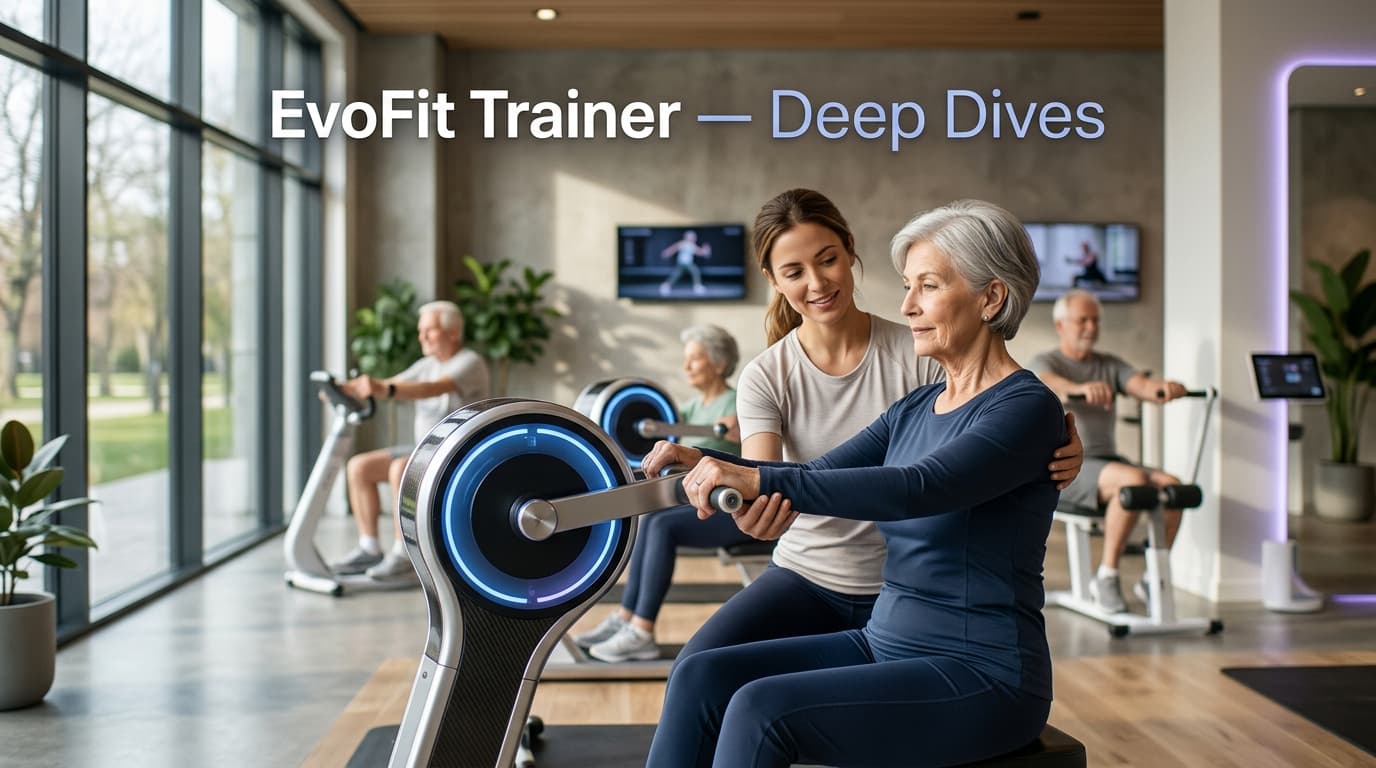
EvoFit Trainer — Deep Dives
In this article
When we built EvoFit Trainer, we started with a simple question: what separates a workout routine that stalls after six weeks from a programme that produces results for years?
The answer, overwhelmingly, points to periodisation — the systematic planning of training variables over time. It is not glamorous. It is not a secret. But it is where the evidence lands, and it is the foundation upon which EvoFit Trainer's AI personalisation is built.
In this deep dive, we unpack the architecture of long-term programme design, the principle of progressive overload, and how our system applies these concepts at scale.
The Case for Thinking in Years, Not Workouts
A single training session is a data point. A mesocycle is a trend. A macrocycle is the narrative. Research consistently demonstrates that long-term periodised programme design outperforms non-periodised training for strength and physical adaptation (Guppy & Haff, 2021). The human body does not respond to individual exercises in isolation; it responds to the cumulative stimulus of organised, progressive loading over weeks, months, and years.
This is why EvoFit Trainer does not simply generate "a workout." It generates a sequence — one where each phase accounts for what came before and prepares for what comes next.
As noted in Advanced Personal Training (2016), long-term training programme design requires manipulating intensity, volume, and exercise selection across interconnected cycles to avoid stagnation and manage fatigue. The text highlights periodisation as the central organising framework coaches use to map adaptation over time.
Understanding the Architecture: Macro, Meso, and Micro
Periodisation operates across three nested timescales:
- Macrocycles (months to years): The overarching plan. For a competitive athlete, this might map to a season. For a general population user, it might map to a 12-month strength and hypertrophy block with defined deload phases.
- Mesocycles (weeks to months): Typically 3–8 week blocks with a specific focus — hypertrophy, strength, power, or metabolic conditioning. These are the building blocks of adaptation.
- Microcycles (days to a week): The day-to-day and session-to-session structure. This is where set, rep, and load decisions are executed.
The interaction between these layers is non-trivial. Guppy and Haff (2021) describe long-term programme design as a process of systematically varying training stimuli to manage the competing demands of fatigue accumulation and adaptation. Get the balance wrong, and you either undertrain (too little stimulus) or overreach without recovery (too much stimulus, too little restoration).
How EvoFit Trainer Handles This
Our AI models programme generation at all three levels simultaneously. When a user begins a new mesocycle, EvoFit Trainer evaluates:
- Prior training history — what volumes and intensities have been accumulated?
- Recovery markers — subjective readiness, performance trends, and completion rates.
- Goal alignment — is the current trajectory consistent with the user's stated long-term objective?
The system then assigns a mesocycle archetype (e.g., accumulation, intensification, deload) and populates microcycles accordingly. This mirrors the manual process a human coach would follow — but it does so consistently, at scale, and without the cognitive bias that creeps into manual programming after the fiftieth client.
Progressive Overload: The Non-Negotiable Principle
If periodisation is the architecture, progressive overload is the construction material. The concept is straightforward: to continue adapting, the training stimulus must increase over time. In practice, this is where most self-directed training programmes fail — not because the concept is misunderstood, but because its execution requires precise, ongoing management.
The literature on long-term strength development under uniaxial tensile loading provides a useful, if unexpected, analogy. Lokoshchenko (2017) examined long-term strength under sustained uniaxial tensile loading, demonstrating that material endurance is governed by the interaction of load magnitude, duration, and the accumulation of micro-damage over time. While this research concerns materials science rather than human physiology, the structural parallel is informative: load management is not about a single maximal effort. It is about the capacity to sustain and incrementally increase demand without catastrophic failure.
In human training, progressive overload can be achieved through several pathways:
- Increasing load (adding weight to the bar)
- Increasing volume (adding sets or repetitions)
- Increasing frequency (adding sessions per week for a given movement pattern)
- Improving execution (enhancing range of motion, control, and tempo)
- Reducing rest intervals (for metabolic adaptations)
The key insight from the periodisation literature is that these pathways cannot all be progressed simultaneously and indefinitely. Guppy and Haff (2021) note that effective long-term programme design strategically alternates which variables are emphasised across mesocycles — a concept sometimes referred to as accentuated adaptation.
EvoFit Trainer's Overload Engine
Our system tracks all five overload pathways and prioritises them based on the user's phase of training, exercise selection, and demonstrated response. For example, during a hypertrophy-focused mesocycle, the system may first progress volume (adding sets) before increasing load. During an intensification block, the logic inverts — volume is reduced as load increases.
This is not arbitrary. It reflects established periodisation models documented in both Guppy and Haff (2021) and Advanced Personal Training (2016), which describe the inverse relationship between volume and intensity as a cornerstone of fatigue management across training phases.
The Problem with Static Programmes
A PDF programme is a static document. It assumes that Week 4 will look exactly like the plan said it would — that you will not get sick, that your sleep will be consistent, that your nutrition will not drift, and that your recovery between sessions will be uniform.
None of these assumptions hold.
The distinction between a static plan and an adaptive one is the distinction between a map and a navigator. A map shows the route; a navigator reroutes you when the road is closed. EvoFit Trainer functions as a navigator. When a user misses sessions, reports elevated fatigue, or demonstrates a performance plateau, the system recalculates — adjusting the subsequent microcycle to maintain the integrity of the mesocycle without forcing a rigid template onto an unpredictable reality.
This adaptive capacity is what makes AI-assisted programming qualitatively different from spreadsheet-based periodisation. The underlying principles are the same. The execution is not.
The Psychological Dimension
Long-term training is not solely a physiological challenge. It is a behavioural and psychological one. Programme adherence is the single largest determinant of long-term outcomes — a well-designed programme that is abandoned in Week 3 is inferior to a mediocre programme that is followed for a year.
Research on personality patterns during occupational deep dives with long-term confinement in hyperbaric chambers examined how individuals psychologically respond to sustained, high-stakes, confined environments (Abraini et al., 1998). The study found that anxiety patterns varied meaningfully by personality profile, and that individuals responded differently to the same environmental stressors depending on their psychological makeup. While the context — saturation diving in hyperbaric conditions — is far removed from a training programme, the underlying observation is broadly applicable: sustained engagement with any demanding, long-term endeavour is moderated by individual psychological characteristics.
This has direct implications for programme design. Two users with identical physiological profiles may require different programming approaches based on their psychological response to training volume, intensity, session frequency, and exercise variety. A user who experiences high-volume training as punishing will not adhere to a high-volume programme, regardless of its theoretical optimality.
EvoFit Trainer incorporates this by tracking engagement signals — session completion rates, time-to-completion, self-reported exertion, and voluntary feedback — as proxies for psychological response. When the system detects declining engagement, it can adjust programme variables (reducing session length, modifying exercise selection, or shifting the mesocycle focus) to improve sustainability.
Nutrition: The Other Variable
Programme design does not exist in a vacuum. Training stimulus interacts with nutritional context to determine adaptation. We will address nutrition science in depth in future deep dives, but it is worth noting here that periodisation applies to nutrition as much as it does to training.
Energy availability, macronutrient distribution, and meal timing all influence the body's capacity to recover from and adapt to training stress. A programme designed for hypertrophy presupposes sufficient caloric and protein intake to support muscle protein synthesis. A programme designed for weight loss presupposes an energy deficit that will inevitably influence training performance and recovery capacity.
EvoFit Trainer's AI takes nutritional context into account when generating and adjusting training plans. This does not mean the system prescribes a diet — it means the system does not design a high-volume hypertrophy block for a user reporting severe caloric restriction without flagging the potential conflict.
What We Do Not Claim
We want to be precise about what EvoFit Trainer does and does not do.
We do not diagnose. We do not treat. We do not provide medical or therapeutic advice. We do not prescribe compounds, supplements, or pharmacological interventions. We do not guarantee outcomes.
What we do is apply established principles of exercise science — periodisation, progressive overload, and adaptive programming — using AI to personalise and adjust training plans based on individual data. The evidence base for these principles is robust (Guppy & Haff, 2021; Advanced Personal Training, 2016), but individual outcomes vary based on genetics, adherence, nutritional context, sleep, stress, and a host of other variables that no system can fully control or predict.
The role of AI is not to replace human expertise. It is to scale it — to make the kind of thoughtful, individualised, periodised programming that was once available only to coached athletes accessible to anyone with a phone and a willingness to show up.
Looking Ahead
In future editions of EvoFit Trainer — Deep Dives, we will examine:
- Nutrition periodisation — how caloric and macronutrient targets should shift across training phases
- Deload science — what the evidence actually says about planned reductions in training volume and intensity
- Auto-regulation — using daily readiness markers to adjust training in real time
- Exercise selection logic — how EvoFit Trainer chooses movements based on equipment availability, movement proficiency, and programme goals
For now, the takeaway is this: effective training is not about the hardest workout you can do today. It is about the smartest sequence of workouts you can sustain over time. That is the principle EvoFit Trainer is built to serve.
Train with intent. Programme with patience. Adapt intelligently.
— The EvoFit Team
References
Abraini, J., Ansseau, M., Bisson, T., et al. (1998). Personality patterns of anxiety during occupational deep dives with long-term confinement in hyperbaric chamber. Journal of Clinical Psychology, 54(6), 825–830. https://doi.org/10.1002/(sici)1097-4679(199810)54:6<825::aid-jclp10>3.0.co;2-n
ACI Materials Journal (2002). Long-term strength development of controlled low-strength material. ACI Materials Journal, 99(4). https://doi.org/10.14359/11708
Advanced Personal Training (2016). Long-term training programme design (periodisation). In Advanced personal training. Routledge. https://doi.org/10.4324/9781315684291-14
Guppy, S., & Haff, G. (2021). Long-term programme design (periodisation). In Strength and conditioning. Routledge. https://doi.org/10.4324/9781003204657-8
Lokoshchenko, A. (2017). Long-term strength in uniaxial tensile loading. In Long-term strength in uniaxial tensile loading. CRC Press. https://doi.org/10.1201/b22242-2
Nursing Critical Care (2017). Long days, deep dives. Nursing Critical Care, 12(5). https://doi.org/10.1097/01.ccn.0000520652.96737.e8
EvoFit Team
AI-powered fitness science, nutrition research, and coaching strategies for the modern fitness professional.