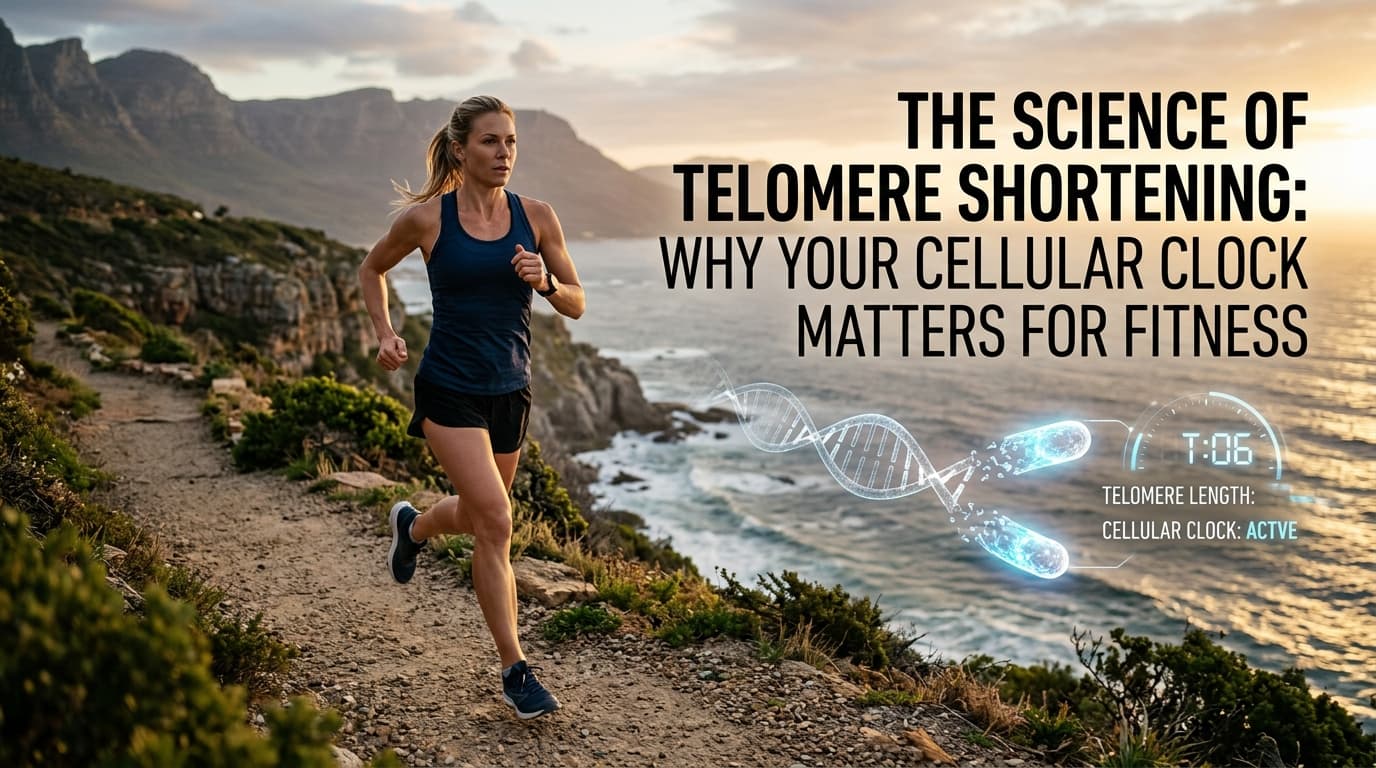
The Science of Telomere Shortening: Why Your Cellular Clock Matters for Fitness
In this article
You track your clients' body weight, body fat percentage, and strength numbers. But there's a biological metric that none of those capture — and it may be the most important one for long-term health and performance: telomere length.
Telomeres are the protective caps at the ends of chromosomes. Every time a cell divides, they get shorter. When they get too short, the cell can no longer divide. This isn't abstract biology — it directly affects recovery capacity, injury risk, immune function, and ultimately how long someone can sustain athletic performance.
This article explains telomere biology in the context of fitness and why emerging peptides like Epitalon that target telomeres are worth understanding.
What Telomeres Do
Think of telomeres like the plastic tips on shoelaces. They protect the ends of chromosomes from fraying, sticking to other chromosomes, or being recognized as damaged DNA. Without telomeres, chromosomes would lose genetic material with each cell division, eventually corrupting essential genes.
Each time a cell divides, the DNA replication machinery can't quite copy the very end of the chromosome. Telomeres sacrifice a small piece of themselves (50-200 base pairs) to protect the coding DNA. This is the "end replication problem" — a fundamental limitation of cellular biology.
The Hayflick Limit
In 1961, Leonard Hayflick discovered that human cells in culture divide approximately 50-70 times before entering senescence. This became known as the Hayflick limit, and telomere shortening is the mechanism that enforces it.
Once telomeres reach a critically short length (typically below 5 kb for leukocyte telomeres), the cell:
- Activates DNA damage response pathways (p53, p21)
- Enters permanent cell cycle arrest (senescence)
- Becomes a "zombie cell" — alive but non-dividing
- Secretes pro-inflammatory compounds (the SASP — senescence-associated secretory phenotype)
Senescent cells accumulate with age, driving chronic inflammation, tissue degeneration, and organ dysfunction.
Telomeres and Fitness
Short telomeres aren't just an aging problem — they're a fitness problem:
Recovery capacity: Muscle repair requires satellite cell proliferation (cell division). Short telomeres in satellite cells limit their ability to regenerate muscle tissue after training.
Immune function: Immune cells (T cells, B cells) must divide rapidly to fight infections. Short telomeres compromise immune response, explaining why older athletes get sick more often and recover from illness more slowly.
Injury healing: Tendon and ligament healing requires fibroblast proliferation. Telomere-shortened fibroblasts produce less collagen and heal more slowly.
Cardiovascular health: Telomere length in vascular endothelial cells is a predictor of cardiovascular disease risk.
Bone density: Osteoblasts (bone-building cells) with short telomeres are less active, contributing to age-related bone loss.
Exercise and Telomeres: The Good News
Here's where it gets interesting for fitness professionals. Exercise has a well-documented positive effect on telomere length:
- Endurance training is associated with longer leukocyte telomeres compared to sedentary controls
- Regular exercisers show telomere lengths equivalent to being 10 years younger biologically than their chronological age
- Resistance training may help preserve telomere length through reduced oxidative stress and improved metabolic health
- The dose-response curve suggests moderate-to-vigorous activity is optimal — extreme endurance (ultramarathons) may actually accelerate telomere shortening through excessive oxidative stress
Exercise works through multiple telomere-protective mechanisms: reduced inflammation, lower oxidative stress, improved DNA repair capacity, and enhanced telomerase activity.
Where Peptides Fit In
Epitalon and other telomerase-activating compounds represent a pharmacological approach to what exercise does naturally — maintaining telomere length. The theoretical appeal is obvious: if exercise can slow telomere shortening, and telomerase activation can reverse it, the combination could be synergistic.
But the evidence hierarchy matters:
- Exercise → telomere maintenance: Well-documented in human epidemiological studies
- Epitalon → telomerase activation: Documented in cell culture and Russian clinical studies
- Exercise + Epitalon → ? Zero published data on this combination
The most responsible position for trainers: optimize exercise and lifestyle factors first (these have proven telomere benefits), and consider pharmacological approaches only as potential supplements to — not replacements for — the fundamentals.
Lifestyle Factors That Affect Telomere Length
Beyond exercise, telomeres respond to:
- Chronic stress: Cortisol accelerates telomere shortening. Meditation and stress management show protective effects.
- Sleep: Sleep deprivation shortens telomeres; adequate sleep (7-9 hours) is protective.
- Nutrition: Antioxidant-rich diets, omega-3 fatty acids, and adequate vitamin D are associated with longer telomeres.
- Smoking and alcohol: Both accelerate telomere shortening significantly.
- Obesity: Excess body fat increases oxidative stress and inflammation, both of which accelerate telomere attrition.
The Bottom Line
Telomere biology is a real, measurable factor in athletic longevity. It's not pseudoscience — it's mainstream molecular biology. Fitness professionals who understand telomere dynamics can better explain why recovery gets harder with age, why sleep and stress management matter for athletic performance, and why consistent exercise is literally a cellular anti-aging intervention.
Peptides like Epitalon may eventually provide a pharmacological tool for telomere maintenance. But the proven interventions — exercise, sleep, nutrition, stress management — should always come first.
References
- Blackburn, E.H., et al. (2015). Telomeres and telomerase: implications for human health and disease. Nature Reviews Molecular Cell Biology.
- Epel, E., et al. (2023). Stress, telomere length, and health. Psychoneuroendocrinology.
- Puterman, E., et al. (2024). Exercise and telomere length in humans. Med Sci Sports Exerc.
- Khavinson, V., et al. (2025). Epitalon and telomerase activation. Biogerontology.
- Hayflick, L. (1965). The limited in vitro lifetime of human diploid cell strains. Exp Cell Res.
This article is for informational purposes only and does not constitute medical advice.
EvoFit Team
AI-powered fitness science, nutrition research, and coaching strategies for the modern fitness professional.