Epitalon and Sleep: The Pineal Gland Connection That Most People Miss
In this article
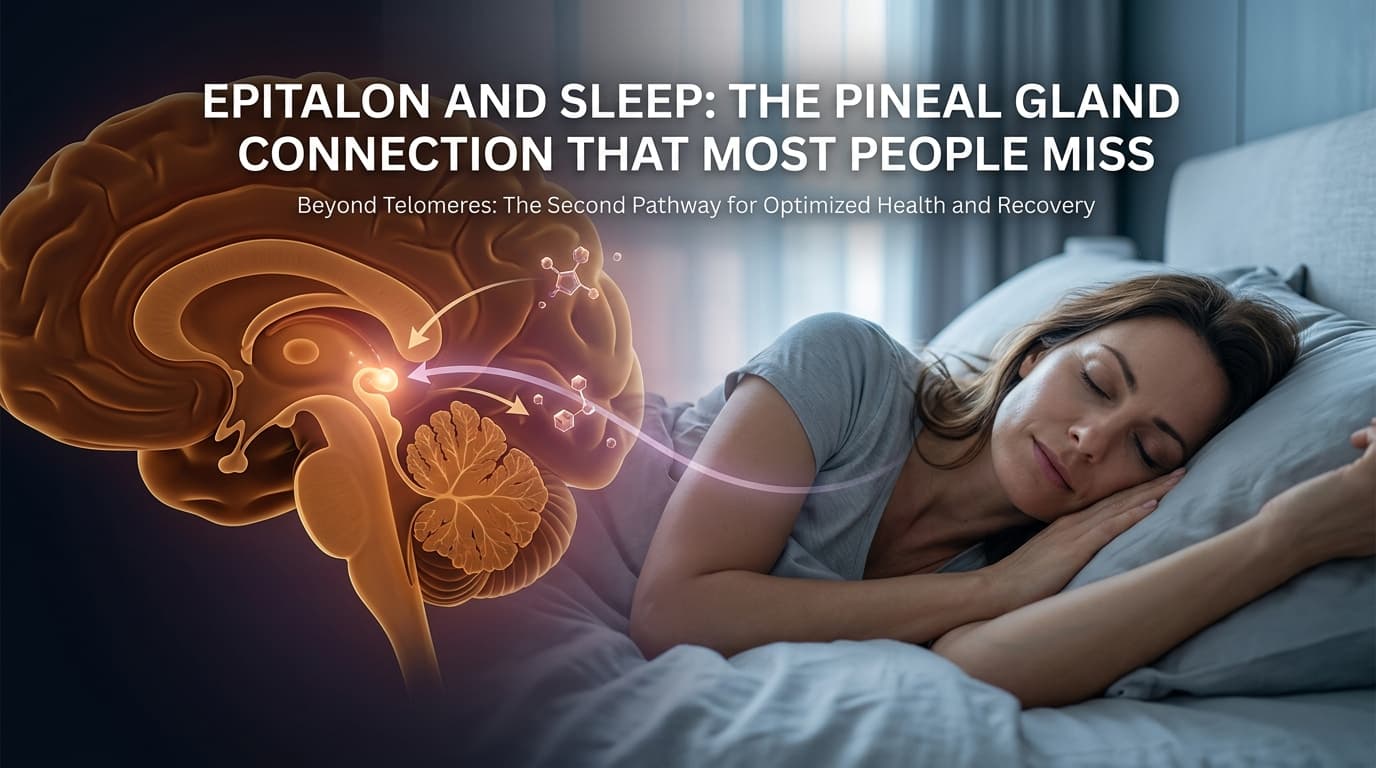
When people talk about Epitalon, they focus on telomeres. Fair enough — telomerase activation is the headline mechanism. But there's a second, underappreciated pathway that might be more immediately relevant to fitness and health: Epitalon's effect on the pineal gland and melatonin production.
For athletes and fitness enthusiasts, sleep is the single most undervalued performance enhancer. If Epitalon can meaningfully improve sleep quality in aging adults — and the early evidence suggests it can — that alone could justify attention.
The Pineal Gland and Aging
The pineal gland is a small endocrine gland in the brain that produces melatonin, the hormone that regulates sleep-wake cycles. With age, the pineal gland calcifies and melatonin production declines dramatically:
- Children produce the highest levels of melatonin
- Melatonin production begins declining in the 20s
- By age 60, melatonin levels are typically 50% or less of youthful levels
- By age 80, many people produce barely detectable amounts
This decline correlates with the sleep disturbances that plague older adults: difficulty falling asleep, frequent waking, reduced deep sleep, and early morning awakening. It also correlates with broader health deterioration — melatonin isn't just a sleep hormone. It's also a potent antioxidant, immune modulator, and anti-inflammatory agent.
How Epitalon Affects the Pineal Gland
Epitalon was originally derived from epithalamin, a natural peptide extract from the pineal gland. Khavinson's research showed that Epitalon:
- Stimulates melatonin synthesis — directly increasing production of the sleep hormone
- Protects pineal gland cells from age-related damage and calcification
- Restores circadian rhythmicity — normalizing the 24-hour hormonal cycle that regulates sleep, cortisol, growth hormone, and other hormones
- Improves pineal gland function markers in elderly patients
This is mechanistically distinct from taking melatonin supplements. Exogenous melatonin provides the hormone directly but doesn't address the underlying decline in pineal gland function. Epitalon stimulates the gland to produce its own melatonin, potentially restoring a more natural hormonal rhythm.
The Sleep Research
Russian clinical studies in elderly patients reported:
- Improved sleep quality (deeper, more restorative sleep)
- Reduced sleep onset latency (falling asleep faster)
- Fewer nighttime awakenings
- Improved subjective sleep satisfaction
- Better daytime alertness and energy
These improvements were consistent across multiple studies involving hundreds of elderly patients. The mechanism — restored endogenous melatonin production — explains why the effects were sustained rather than transient.
Why This Matters for Athletes
Sleep is the foundation of athletic recovery:
- Growth hormone release peaks during deep sleep (stages 3-4). Declining melatonin = declining deep sleep = declining GH release.
- Muscle protein synthesis is modulated by circadian hormones. Disrupted circadian rhythms impair recovery.
- Testosterone follows a circadian pattern. Poor sleep reduces testosterone levels.
- Cognitive function — reaction time, decision making, and motor learning all depend on adequate sleep.
- Injury risk increases with sleep deprivation. Athletes sleeping less than 7 hours have 1.7x higher injury rates.
If Epitalon can restore youthful sleep architecture in aging athletes, the downstream effects on recovery, hormone production, and performance could be substantial — independent of any telomere effects.
The Evidence Gap
The sleep data comes from Russian studies in elderly populations (60-80+ years). There are no published studies on Epitalon's sleep effects in younger, athletic populations. The degree to which a 35-year-old athlete would benefit from pineal gland stimulation is unknown — their melatonin production may not yet be significantly declined.
There are also no studies combining Epitalon with athletic training programs to measure the interaction between improved sleep and exercise recovery.
Practical Implications
For trainers working with clients over 40 who report sleep disturbances, the Epitalon-sleep connection is worth understanding. It's a different approach from melatonin supplementation, sleep hygiene improvements, or magnesium — it addresses the root cause (pineal gland decline) rather than the symptom.
But the same caveats apply: Russian-only data, no independent replication, not FDA-approved. The conversation should be informational, not prescriptive.
References
- Khavinson, V. (2002). Peptide regulation of aging. Neuro Endocrinol Lett, 23(suppl 3).
- Khavinson, V., et al. Epitalon and pineal gland function in elderly patients.
- Medical University of Warsaw (2025). Multi-pathway geroprotector review. Int J Mol Sci.
- Mah et al. (2024). Sleep and athletic performance. Sports Medicine.
- Milewski et al. (2023). Sleep deprivation and injury risk in athletes. J Sci Med Sport.
This article is for informational purposes only and does not constitute medical advice.
EvoFit Team
AI-powered fitness science, nutrition research, and coaching strategies for the modern fitness professional.