Epitalon vs Other Longevity Peptides: MOTS-c, SS-31, and Humanin Compared
In this article
Epitalon isn't the only peptide targeting aging mechanisms. The longevity peptide landscape includes several compounds with distinct mechanisms, evidence levels, and practical considerations. This article compares Epitalon with three other notable longevity peptides: MOTS-c, SS-31 (Elamipretide), and Humanin.
The Contenders
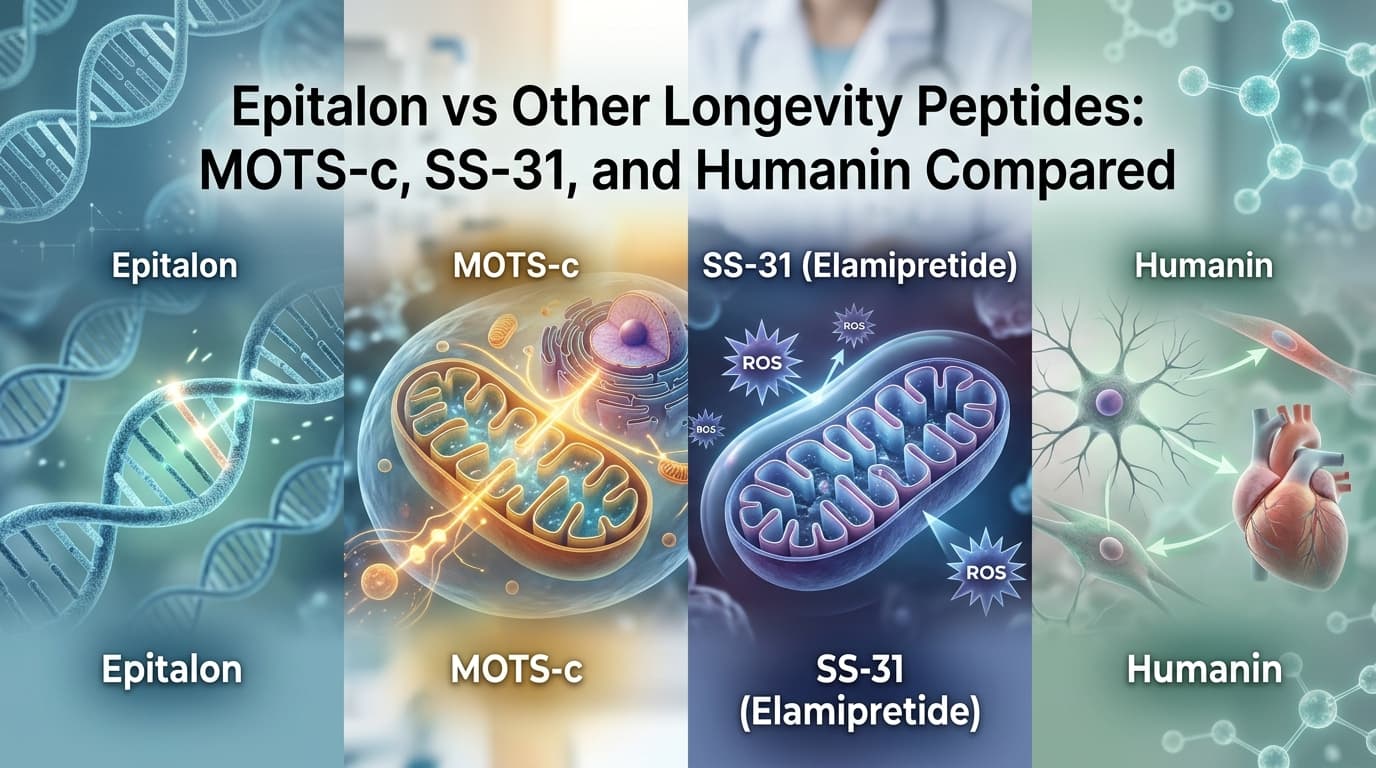
Epitalon — Telomerase activation, pineal gland support, multi-pathway geroprotector MOTS-c — Mitochondrial-derived peptide, exercise mimetic, metabolic regulation SS-31 (Elamipretide) — Mitochondrial inner membrane protection, cardiolipin binding Humanin — Mitochondrial-derived peptide, cytoprotection, neuroprotection
Mechanism Comparison
Epitalon targets telomeres — the fundamental aging clock. By activating telomerase and elongating telomeres, it addresses cellular replicative capacity. Secondary mechanisms include pineal gland support, melatonin production, antioxidant defense, and immune modulation.
MOTS-c is a mitochondrial-derived peptide (16 amino acids) encoded in the mitochondrial genome, not nuclear DNA. It translocates to the nucleus during metabolic stress and regulates adaptive responses including AMPK activation, folate metabolism, and glucose regulation. It's been described as an "exercise mimetic" because it activates some of the same pathways as physical exercise.
SS-31 (Elamipretide) binds to cardiolipin, a phospholipid unique to the mitochondrial inner membrane. This stabilizes the electron transport chain, improves ATP production efficiency, reduces reactive oxygen species (ROS) production, and protects mitochondria from damage. It has the most advanced clinical development of any longevity peptide — Phase 2 and Phase 3 trials for rare mitochondrial diseases and age-related conditions.
Humanin is a 24-amino-acid mitochondrial-derived peptide that interacts with cell surface receptors (CNTFR/WSX-1/gp130) and intracellular targets to protect cells from apoptosis, oxidative stress, and inflammatory damage. It's neuroprotective, cardioprotective, and metabolically active. Circulating Humanin levels decline with age.
Evidence Level Comparison
| Peptide | Animal Data | Human Clinical Data | Independent Replication | Clinical Stage |
|---|---|---|---|---|
| Epitalon | Strong (25+ years, Russian) | Preliminary (Russian only) | Minimal outside Khavinson group | Research chemical |
| MOTS-c | Growing (metabolic, exercise) | Very limited (pilot studies) | Yes, multiple groups | Research chemical |
| SS-31 | Strong (mitochondrial) | Phase 2/3 completed | Yes, extensively | Phase 3 (rare diseases) |
| Humanin | Moderate (neuro/cardio) | Very limited | Yes, multiple groups | Research chemical |
SS-31 has the most robust clinical development by far, with multiple completed trials for primary mitochondrial myopathy, Barth syndrome, and Leber hereditary optic neuropathy. However, these are for rare diseases, not general longevity.
Relevance to Fitness and Aging
Epitalon: Most relevant for clients concerned about biological aging, telomere health, and sleep quality. The broadest multi-pathway approach.
MOTS-c: Most relevant for clients interested in metabolic optimization. The exercise mimetic angle makes it theoretically appealing for enhancing training adaptations, particularly in older adults whose mitochondrial function has declined.
SS-31: Most relevant for clients with known mitochondrial dysfunction, cardiovascular concerns, or age-related energy decline. The most clinically advanced, but also the most targeted (mitochondria-specific).
Humanin: Most relevant for neuroprotection and cognitive health. Emerging evidence for cardiovascular protection. May complement exercise programs for older adults.
The Synergy Question
Could these peptides work better together? Theoretically, yes:
- Epitalon addresses cellular aging (telomeres) + hormonal aging (pineal gland)
- MOTS-c or SS-31 address mitochondrial aging
- Humanin adds neuroprotection
But there are zero published studies testing any combination of these peptides. The synergy is hypothetical, and the potential for unexpected interactions is unknown.
Practical Assessment
For fitness professionals, the honest summary is:
- None of these peptides have sufficient evidence to recommend as proven longevity interventions.
- SS-31 has the strongest clinical data but is targeted at rare diseases, not general anti-aging.
- Epitalon has the most longevity-specific mechanism (telomerase activation) but the most concentrated research base (single group, Russian protocols).
- MOTS-c has the most fitness-relevant mechanism (exercise mimetic) but the least clinical data.
- Humanin occupies a niche — neuroprotection with some metabolic benefits.
The conversation with clients should always be grounded in what the evidence actually supports, not what the longevity community hopes it might eventually show.
References
- Khavinson, V., et al. (2025). Epitalon telomere study. Biogerontology.
- Kim, K.H., et al. (2024). MOTS-c: Mitochondrial-derived peptide in metabolic regulation. Cell Metabolism.
- Szeto, H.H., et al. (2023). SS-31 mechanism and clinical development. J Pharmacol Exp Ther.
- Yen, K., et al. (2024). Humanin and mitochondrial peptides in aging. Nature Aging.
- Medical University of Warsaw (2025). Multi-pathway geroprotector review. Int J Mol Sci.
This article is for informational purposes only and does not constitute medical advice.
EvoFit Team
AI-powered fitness science, nutrition research, and coaching strategies for the modern fitness professional.