Epitalon: The Telomere Peptide That Could Change How We Age
In this article
Most peptides in the fitness world are about recovery or weight loss. Epitalon is about something fundamentally different: how long your cells can keep dividing.
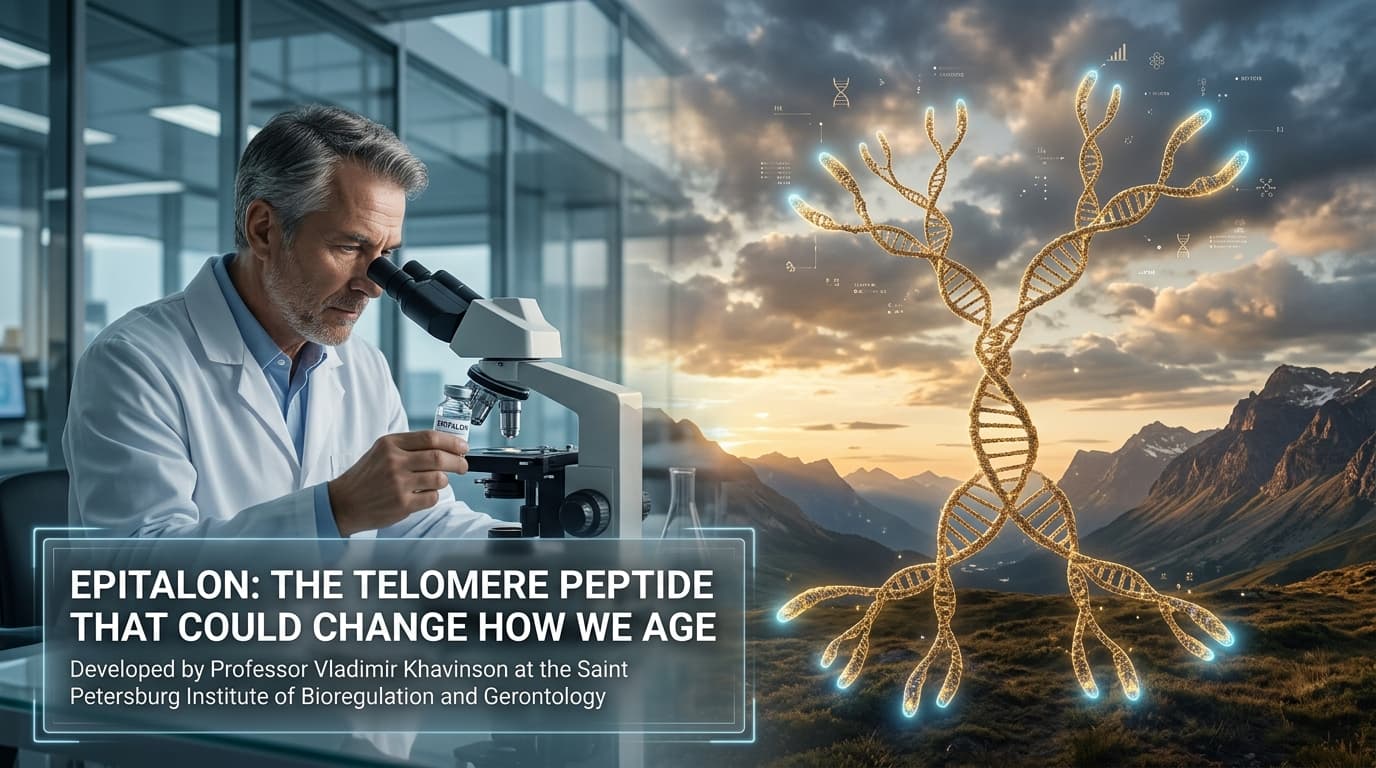
Developed by Professor Vladimir Khavinson at the Saint Petersburg Institute of Bioregulation and Gerontology, Epitalon (also called Epithalon) is a synthetic tetrapeptide (Ala-Glu-Asp-Gly) derived from epithalamin, a natural compound produced by the pineal gland. Its primary mechanism — telomerase activation — targets one of the foundational mechanisms of aging itself.
This article explains what Epitalon does, what the research shows, and why it's generating interest in the longevity community.
Telomeres: The Cellular Clock
Every time a cell divides, the telomeres — protective caps at the ends of chromosomes — shorten slightly. After enough divisions (the Hayflick limit, roughly 50-70 for human fibroblasts), telomeres become critically short, and the cell enters senescence. It stops dividing. It doesn't die — it becomes a "zombie cell" that secretes inflammatory compounds, damages neighboring cells, and contributes to tissue aging.
Telomerase is the enzyme that can rebuild telomeres, effectively resetting the cellular clock. Most human cells express very low levels of telomerase. Cancer cells express high levels (which is why they can divide indefinitely). The challenge for anti-aging therapy has been activating telomerase enough to extend healthy cellular lifespan without increasing cancer risk.
What Epitalon Does
Epitalon activates telomerase through epigenetic remodeling. Specifically:
-
Promoter binding: Epitalon binds to the promoter region of the telomerase gene (hTERT), making it more accessible for transcription.
-
Chromatin remodeling: It modifies chromatin structure around telomerase-related genes, effectively "unlocking" them.
-
Telomere elongation: Once telomerase is active, it adds telomeric repeats (TTAGGG) to chromosome ends, lengthening telomeres.
A September 2025 study published in Biogerontology confirmed that Epitalon increases telomere length in human cell lines through both telomerase upregulation and Alternative Lengthening of Telomeres (ALT) activity.
The Animal Data
Khavinson's research group demonstrated:
- 25% lifespan extension in mice treated with Epitalon
- Increased maximum lifespan in female Swiss-derived SHR mice by 12.3%
- Slowed age-related decline of reproductive function
- Reduced frequency of chromosome aberrations
- Extended lifespan without inducing tumor growth — a critical safety signal
The absence of increased tumor incidence is significant. The primary theoretical concern with telomerase activation is cancer promotion. Epitalon's animal data suggests it may avoid this risk, though human confirmation is needed.
The Human Data
Human studies, primarily from Khavinson's Russian research group, have reported:
- Increased telomere length in blood cells of patients aged 60-80
- One case report showed telomere length increase from 6.45 to 6.59 kb over one year
- Improved sleep quality, emotional stability, and physical stamina in elderly patients
- A placebo-controlled trial in 70 older adults with cardiovascular disease showed 28% decreased mortality over 12 years following 3 years of treatment
- Restored melatonin secretion in aged humans
Critical caveat: These results come almost exclusively from Khavinson's own research group and have not been independently replicated by Western researchers. The studies were conducted under Russian research protocols, which may differ from Western clinical trial standards.
Additional Mechanisms
Beyond telomerase activation, Epitalon appears to:
- Restore circadian rhythms by stimulating melatonin synthesis in the pineal gland
- Enhance antioxidant defenses by boosting key antioxidant enzymes and reducing oxidative damage markers
- Modulate immune function — recalibrating age-related immune decline
- Protect mitochondrial integrity — preserving cellular energy production
- Reduce inflammation — lowering systemic inflammatory markers
The 2025 multi-pathway review from the Medical University of Warsaw characterizes Epitalon as a "multi-pathway geroprotector" — not just a telomerase activator, but a compound that addresses multiple hallmarks of aging simultaneously.
Regulatory Status
Epitalon is not FDA-approved and is classified as a research chemical in most jurisdictions. It is not on the WADA prohibited list specifically, but its telomerase-activating properties could potentially fall under general anti-doping provisions.
The Honest Assessment
Epitalon has the most compelling mechanistic rationale of any longevity peptide: it targets telomeres, which are a fundamental aging mechanism. The animal data is encouraging. The human data, while preliminary and lacking independent replication, is better than most peptides can claim.
But 25 years of research concentrated in a single research group, without independent Western replication, is a significant limitation. The leap from Russian clinical protocols to Western regulatory approval is enormous.
For fitness professionals, Epitalon represents the frontier of longevity science — worth understanding, worth watching, but not worth recommending to clients as a proven therapy.
References
- Khavinson, V., et al. (2025). Epitalon telomere elongation study. Biogerontology (September 2025).
- Medical University of Warsaw (2025). Multi-pathway geroprotector review. Int J Mol Sci.
- Khavinson, V. (2002). Peptide regulation of aging. Neuro Endocrinol Lett, 23(suppl 3).
- Anisimov, V.N., et al. (2003). Epitalon and lifespan in mice. Biogerontology, 4(4).
- Araj et al. (2025). Epitalon telomerase activity in bovine cumulus cells.
This article is for informational purposes only and does not constitute medical advice.
EvoFit Team
AI-powered fitness science, nutrition research, and coaching strategies for the modern fitness professional.