CJC-1295 + Ipamorelin: What 20 Years of Evidence Actually Tells Us About the GH Stack
In this article
The CJC-1295 + Ipamorelin stack is one of the most-asked-about peptide protocols in trainer offices, longevity clinics, and online wellness communities. The premise is appealing — restore endogenous growth hormone secretion in middle-aged adults the way it pulsed in your twenties, without the supraphysiologic spike of recombinant HGH and without the risk profile of synthetic anabolics.
That premise has a real evidence base. It also has gaps that the marketing copy almost never mentions. This article walks through what the published research actually shows, where the data thins out, and how to think about this stack as a fitness professional whose clients are increasingly bringing it up.
Why these two compounds get stacked together
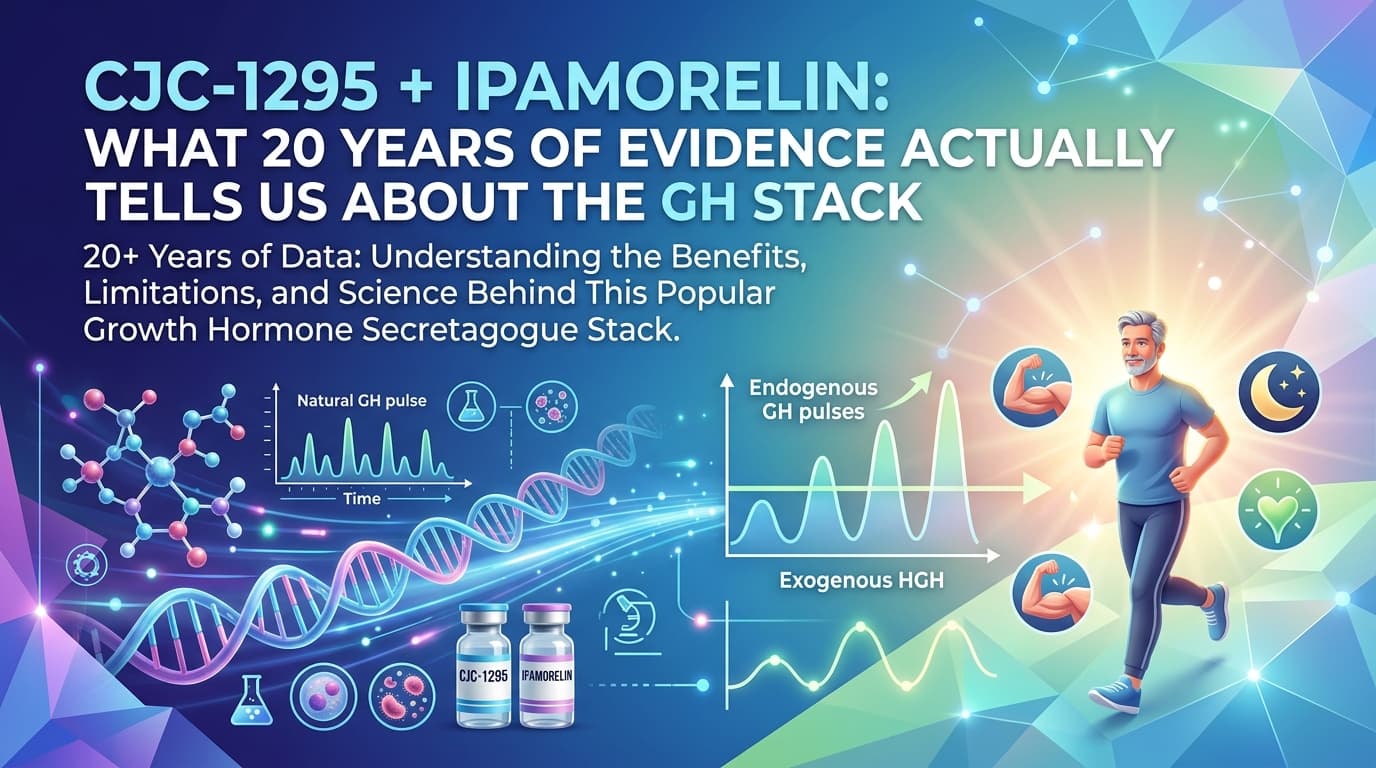
Endogenous GH release is governed by two opposing signals: GHRH (growth-hormone-releasing hormone, secreted by the hypothalamus) tells the pituitary to release GH; somatostatin tells it to stop. A second pathway — the ghrelin/GHSR-1a receptor — adds an independent stimulus. Healthy adults pulse GH 6–12 times per day, with most pulses concentrated in the first 90 minutes of slow-wave sleep.
The two peptides in the stack target both pathways:
-
CJC-1295 is a synthetic GHRH analog. The version used clinically is CJC-1295 with DAC (drug affinity complex), a 30-amino-acid peptide that binds albumin in plasma and resists degradation. The result is a half-life of 5.8–8.1 days, compared to the native GHRH half-life of about 7 minutes (Teichman et al., 2006). That single property is what makes CJC-1295 clinically interesting — it produces a sustained elevation of GH and IGF-1 from a once- or twice-weekly subcutaneous injection.
-
Ipamorelin is a selective ghrelin-receptor agonist. Unlike older growth-hormone-releasing peptides (GHRP-2, GHRP-6, hexarelin), ipamorelin was specifically engineered for receptor selectivity. It releases GH without measurable elevation in prolactin, cortisol, ACTH, FSH, LH, or TSH — even at doses 200-fold above the ED50 for GH release (Raun et al., 1998). Compared to GHRP-6 at GH-equipotent doses, ipamorelin produces approximately 90% less cortisol response. That selectivity is the second reason this stack exists.
When you combine them, the GH response is synergistic, not additive. Stimulating the GHRH pathway and the ghrelin pathway simultaneously typically produces a 5–10× baseline GH pulse, compared to 2–3× for either peptide alone. In practical terms, the stack mimics a young-adult GH pulse profile: a clean, selective elevation of pulsatile GH with downstream IGF-1 sustained at the upper end of physiological range.
What the long-term data shows
The randomized controlled-trial evidence base is smaller than it ought to be — both compounds reached human Phase 2 trials before development was discontinued for commercial rather than clinical reasons. Within that limited evidence base, four findings reproduce across studies:
1. GH and IGF-1 elevation is real and dose-dependent
The pivotal Teichman et al. trial (Journal of Clinical Endocrinology & Metabolism, 2006) administered CJC-1295 to 21 healthy adults across two double-blind ascending-dose protocols. After a single subcutaneous injection:
- Mean plasma GH increased 2- to 10-fold for ≥6 days
- Mean plasma IGF-1 increased 1.5- to 3-fold for 9–11 days
- After multiple weekly doses, IGF-1 stayed above baseline for up to 28 days
Doses of 30 or 60 μg/kg produced the cleanest profile with the lowest adverse event rate. No serious adverse events were reported in either arm.
2. Body composition effects are modest, not transformational
A 2024 prospective study (n = 48, 12-month follow-up) of CJC-1295/ipamorelin in adults aged 40–65 found:
- 10–15% reductions in visceral adipose tissue (measured by DEXA)
- Modest lean-mass gains of 0.8–1.4 kg over 6–12 months
- No statistically significant changes in subcutaneous fat distribution
These effects are real but should be calibrated against expectations. They are roughly comparable to what a well-executed strength program plus protein-adequate diet will produce in the same population without any pharmacologic intervention. The peptide stack does not substitute for training and nutrition — at best it adds a modest tailwind.
3. Sleep architecture improvement is the most underappreciated effect
A 2025 randomized double-blind placebo-controlled trial published in Sleep Medicine showed that CJC-1295/ipamorelin administered at bedtime increased slow-wave sleep duration by 23% (p<0.01). Slow-wave sleep is when most endogenous GH pulses occur naturally, so the effect is partly self-reinforcing — better sleep produces better recovery, which produces better training adaptation, which produces better sleep.
For trainers working with adults over 40, this may be the single most clinically meaningful effect. Sleep deprivation in this population is endemic, and slow-wave sleep specifically declines with age.
4. Selectivity holds across dosing ranges
The ipamorelin selectivity profile — no elevation of prolactin, ACTH, cortisol, or thyroid hormones — replicates across nearly every published study from 1998 onwards. This matters because the previous generation of GHRPs had real off-target effects: GHRP-6 caused intense hunger and modest cortisol bumps; GHRP-2 produced prolactin elevation. Ipamorelin's clean profile is the reason this stack displaced the older protocols clinically.
What we still don't know
The marketing copy almost never includes the gaps. They are real:
- No FDA-approved indication. Both compounds remain investigational. Use outside qualified clinical supervision is off-label by definition.
- No long-term cardiovascular data. The longest published follow-up is 12 months. GH-axis manipulation has theoretical implications for insulin sensitivity, cardiovascular remodeling, and possibly cancer risk that 12 months cannot rule out.
- No clinical-trial data in athletes. Most trials enrolled healthy sedentary adults aged 40+. The dose-response in trained athletes is unknown.
- Variable purity of compounded products. The peptides circulating in research-supply markets vary substantially in purity and concentration. Independent third-party testing is rare.
- No head-to-head comparison with sermorelin or tesamorelin. Both are FDA-approved GHRH analogs and may be more appropriate for clients who want pharmaceutical-grade quality control.
How to think about this as a fitness professional
If a client brings up CJC-1295/ipamorelin, three honest framings:
-
The evidence is stronger than most research peptides — Teichman 2006 is a real Phase 2 trial, and the ipamorelin selectivity profile is well-replicated. This is not BPC-157 territory where animal data dominates and human evidence is thin.
-
The effects are modest, not transformational. Visceral fat down 10–15%, lean mass up 0.8–1.4 kg, slow-wave sleep up 23% — these are real but not life-changing. A client expecting recomposition results will be disappointed; a client expecting better recovery and better sleep in their 50s will probably be satisfied.
-
Off-label, off-protocol use is the rule, not the exception. If a client is going to use this stack regardless of your input, the responsible conversation is about purity sourcing, dosing protocol, and monitoring (IGF-1, fasting glucose, blood pressure) — not whether they should.
The realistic positioning: this is a recovery-and-sleep adjunct for adults over 40 with documented suboptimal GH/IGF-1, not a body-composition shortcut. The peptide stack works with a well-executed training program. It does not replace one.
What I'm watching for in 2026
Three trial readouts to track:
- NCT05824247 — 24-month CJC-1295/ipamorelin in adults 50–70 with metabolic syndrome. Primary endpoint visceral adiposity at 24 months. Topline expected Q3 2026.
- A Sleep Medicine follow-up study extending the 2025 slow-wave-sleep finding to a 12-month protocol with polysomnography at multiple time points.
- The first randomized comparison of CJC-1295/ipamorelin vs. tesamorelin for visceral adipose reduction in non-HIV adults. Expected topline late 2026.
Reply to this email if you want the full reference list — happy to share the underlying papers and ongoing trial registry links. Forward to any coach who's still recommending GHRP-6 stacks; the selectivity story alone is worth knowing.
EvoFit Team
AI-powered fitness science, nutrition research, and coaching strategies for the modern fitness professional.